
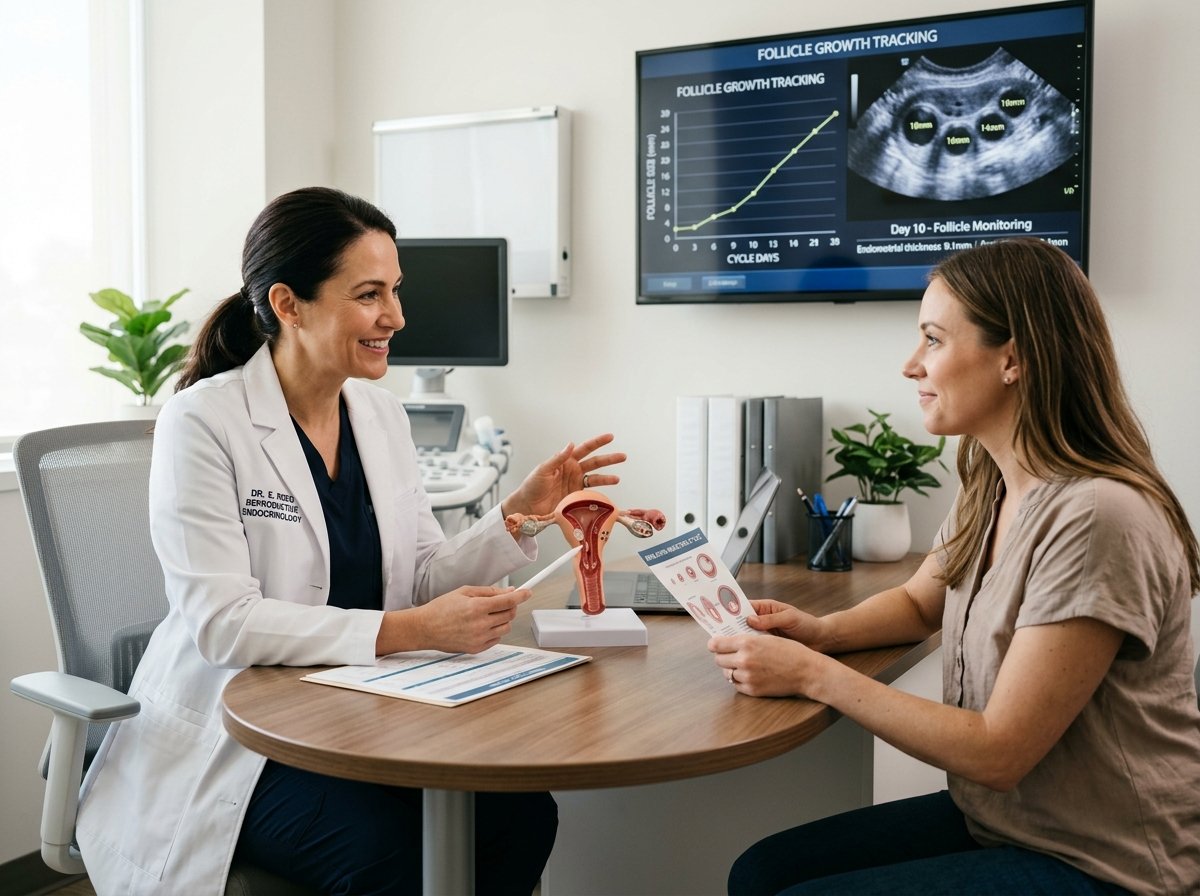
What is Ovulation Induction?
Ovulation Induction (OI) is a fertility treatment used when a woman does not ovulate regularly or needs help producing a mature, healthy egg. Medicines stimulate the ovaries to recruit, grow, and release an egg, and treatment is coordinated with carefully timed intercourse or intrauterine insemination (IUI).
For many couples experiencing anovulation or irregular cycles due to PCOS, ovulation induction provides a simple, minimally invasive, and cost-effective pathway to pregnancy without needing immediate advanced ART.
Who May Benefit?
Irregular or Absent Ovulation
Women with oligomenorrhea (infrequent periods) or amenorrhea (absent periods) who rarely release eggs naturally.
AnovulationPCOS / PCOD Conditions
Polycystic Ovary Syndrome where multiple immature follicles fail to mature and ovulate on their own.
PCOS ProtocolHormonal Imbalances
Disruptions in pituitary gonadotropins, elevated prolactin, or thyroid issues that interfere with normal follicular development.
Endocrine FactorsUnexplained Infertility
Couples with normal diagnostic tests where superovulation enhances the chance of egg release and fertilization.
SuperovulationCommon Ovulation Medicines
Letrozole (First-Line for PCOS)
An aromatase inhibitor often chosen as the first-line oral medicine for ovulation induction, particularly in women with PCOS. It temporarily lowers estrogen levels, signaling the pituitary gland to naturally produce more Follicle-Stimulating Hormone (FSH).
- Taken orally for 5 days early in the cycle (usually Days 2–6 or 3–7).
- Higher live birth rates and lower multiple pregnancy risk compared to older oral medications in PCOS.
Clomiphene Citrate (Clomid)
A selective estrogen receptor modulator (SERM) that blocks estrogen receptors in the brain, prompting the hypothalamus to release GnRH and the pituitary to secrete FSH and LH.
- Taken orally for 5 days early in the menstrual cycle.
- Effective for women with normal estrogen levels and intact hypothalamic-pituitary function.
Gonadotropin Injections (FSH / hMG)
Injectable gonadotropins directly stimulate the ovarian follicles. Used when oral medicines do not result in ovulation, or when controlled ovarian superovulation is required before IUI.
- Administered via tiny daily subcutaneous injections.
- Requires rigorous transvaginal ultrasound monitoring and estradiol tracking to avoid multiple ovulation.
How Treatment Works
Baseline Scan
Ultrasound scan on Day 2 or 3 of period to ensure ovaries are resting with no cysts before starting medication.
Follicle Monitoring
Serial transvaginal ultrasounds starting around Day 9–11 to measure follicle growth and endometrial lining thickness.
Trigger & Timing
When the leading follicle reaches 18–20mm, an hCG trigger shot coordinates ovulation precisely within 36–40 hours.
Conception Window
Couples have timed intercourse or undergo IUI at the optimal window, followed by a pregnancy test 14 days later.
Timed Intercourse vs IUI
Timed Intercourse
Intercourse is scheduled around the expected time of ovulation (calculated by ultrasound and trigger shot). Ideal when sperm parameters and fallopian tubes are completely normal.
Intrauterine Insemination (IUI)
Washed, highly concentrated sperm is placed directly inside the uterus via a tiny catheter at ovulation. Especially useful for mild male factor, cervical factors, or unexplained infertility.
Important Considerations
Treatment Goal & Safety Protocol
The primary goal is to safely achieve the release of 1–2 mature eggs while strictly minimising the risks of multiple pregnancy (twins/triplets) and Ovarian Hyperstimulation Syndrome (OHSS). In cases where too many follicles develop, our specialists adjust medication dosage or cancel the cycle to protect patient safety.